

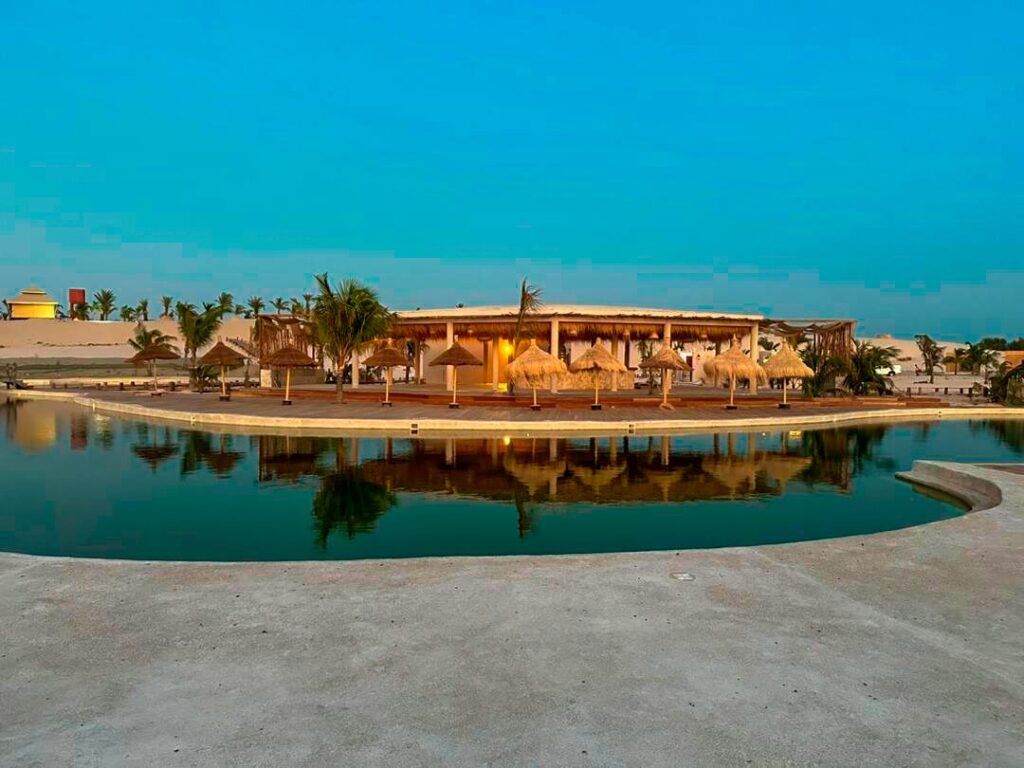
Hotel Interior Design in Senegal: How Earth Architecture Inspired Our Project
Some projects do not begin with a plan. They begin with a conversation, a walk, a texture under the hand. Our hotel project in Senegal began like this: observing the setting, listening to the place and understanding that design should not impose itself but emerge from what was already there. In a territory where architecture is built with time, community and local material, we learned that designing also means knowing when to stop. This is one of those unusual stories that transform the way we design and remind us that the best interior design projects are born from a deep understanding of the context. Designing a Hotel in Senegal: When the Place Sets the Process Designing in Senegal meant stepping outside the usual framework of international interior design. Here, the creative process is not accelerated: it adapts. The climate, the light, local rhythms and the availability of materials set the tempo of the project. Before defining concepts, we visited workshops, building sites in progress and traditional constructions. We observed how walls are raised, how earth is mixed and how knowledge is passed from generation to generation without the need for plans. That first contact redefined our way of approaching the project. The creative process stopped being linear and became a constant conversation with the setting. We understood that the most valuable hotel design is born not only from an idea, but from the ability to listen to what the place already has to say. Earth Architecture and Local Materials: The Origin of the Concept. The key moment came in front of an adobe wall. Imperfect, dense and warm. A wall that did not seek to be beautiful, but was. The compressed earth, worked by hand, responded to the climate, regulated temperature and created a sense of refuge that is hard to replicate with industrial materials. We then understood that this wall was not just a construction solution, but a design lesson. We decided that the hotel had to be born from there: from local material and from traditional techniques reinterpreted with a contemporary outlook. It was not about copying an existing architecture, but about translating its principles into a present-day language. Earth architecture showed us that local materials contain an intelligence of their own, able to respond naturally to the climate, to use and to the identity of the place. Interior Art Direction Inspired by Local Culture. One of the great challenges was finding the balance between interior art direction and cultural respect. The aim was not to create an African set for an outside gaze, but to design an honest, contemporary space deeply connected to its surroundings. We worked with neutral palettes, local materials, local textiles and an interior architecture that breathes. Every decision — from volumes to lighting — sought to amplify the strength of the space without eclipsing its origin. Luxury, in this context, is not in the sophisticated but in the coherent. In letting the material speak. In allowing shadow, texture and silence to be part of the spatial experience. Art direction thus became a tool for revealing the identity of the place, not for transforming it. International Interior Design: Adapting Design to the Cultural Context. This project in Senegal reminded us of something essential: the international design is not about replicating a language, but about knowing how to adapt it. The most valuable interior design projects are those that allow themselves to be transformed by the place where they are born. Those where the designer arrives not with closed answers, but with honest questions. Working from this openness not only enriches the project, but redefines professional practice. It obliges us to unlearn, to listen and to trust processes that are not always immediate, but are deeply authentic. Designing in different cultural contexts requires sensitivity, observation and respect. Only then is it possible to build spaces with an identity of their own and lasting relevance. What Did Senegal Teach Us About Sustainable Interior Design? This hotel is not just another project. It is an experience that will continue to accompany us in future work, in other countries and in other contexts. Senegal taught us that: Local material has an intelligence of its own. Traditional processes contain contemporary solutions. The most powerful design is born when it is built from respect. These lessons reinforce our vision of Sustainable interior design: a way of designing that understands context as an opportunity and not as a limitation. Because sustainability does not depend only on materials. It also depends on the ability to create spaces coherent with the place where they exist.
Hotel Interior Design in Senegal: How Earth Architecture Inspired Our Project Read Post »